A cover up uncovered
My wife, Kathleen Beardsmore, died at the Mount hospital, Leeds, on 11 August 2017.
An inquest into Kathleen’s death was held, at Wakefield Coroners Court, between 11th and 15th November 2019.
The Coroner was Jonathan David Leach.
This is Kathleen’s story.
It is the story of a vulnerable, elderly, lady whose chance of survival was lost because of a gross breach of a duty of care by hospital staff.
It is the story of lies told, by staff at the Mount and others, to cover up that breach.
It is an examination of the conduct of the coroner.
It is the story of a NHS internal enquiry, designed to absolve the Trust of any responsibility but, instead, raised questions about the integrity of the Trust’s legal representative.
It is the story of a neglect of duty by West Yorkshire Police.
I will set out the evidence and let the reader decide where the truth lies.
Care at the Mount hospital
By the 7th August 2017 I had become increasingly concerned about the standard of Kathleen’s care at the Mount.
In the month that Kathleen had been at the Mount, Kathleen, already very slim, had experienced a weight loss of 5 kilos, from 49 kilos to 44 kilos.
I later discovered that advice from a nutritionist had been ignored by staff.
On the previous Thursday Kathleen had been so upset by a male member of staff, that she was taken to Leeds General Infirmary when her blood pressure rose to 213.
It was only later that I discovered that member of staff was Paul Kiely.
Paul Kiely, a charge nurse at the Mount, was Kathleen’s designated primary carer.
I wrote a letter of complaint, regarding the then unknown member of staff, to Dr Tim Branton which he received on 7th August.
Dr Branton was psychiatric consultant at the Mount with responsibility for Kathleen’s care.
Dr Branton came to see me that evening in Kathleen’s room.
He did not identify the male nurse involved.
He suggested that Kathleen had misconstrued the situation which so badly upset her.
It is the stock response when vulnerable patients make complaints.
I knew Kathleen had told me exactly what had taken place.
In Kathleen’s own words’ He read me the riot act.’
Dr Branton went on to say that he believed Kathleen may have been misdiagnosed and may not have the psychotic condition originally diagnosed.
He said Kathleen’s condition may be due to Parkinson’s or to medication.
Kathleen had been detained, at the Mount, under a section.
That evening I left Kathleen in good spirits.
That same night I contacted a solicitor, Gail Guest, and engaged her services with a view to making an application to have the section lifted.
I returned to the Mount at 2pm, the following day, to discover Kathleen had been sedated with a drug I later discovered was Lorazepam.
Amongst the listed side effects are confusion and extreme difficulty in breathing [1].
Staff, administering Lorazepam, should have been aware of those side effects and been on the alert for them.
Studies in the USA has shown that over 61% of females over the age of 60, develop pneumonia having been given Lorazepam. [2]
The incidence of death, from pneumonia, amongst those female patients is extremely high.
I was told that Kathleen had been sedated because of a reluctance to go into the dining room at breakfast.
Other teams had not sedated Kathleen.
They had allowed Kathleen to eat in another room.
A sedation under those circumstances seemed extreme and unnecessary.
The nurse involved was Harriet Owen.
9 August 2017 was Kathleen’s 73rd birthday.
I arrived for the 2pm visit to find Kathleen had been sedated with Lorazepam yet again.
Again, the nurse involved was Harriet Owen.
Only one was of those sedations was entered in Kathleen’s medical records.
I asked Harriet Owen if I could stay with Kathleen following the afternoon visit.
Harriet Owen refused me permission to do so.
10 August 2017
At 5.50am on 10 August 2017 I contacted the Mount and asked them not to sedate Kathleen for a third successive day.
I visited Kathleen at 2pm that day.
Kathleen could hardly walk, was struggling to breathe and unable to speak.
I know now that Kathleen was suffering from the pneumonia which was to lead to her death.
An examination by a competent physician would have identified the condition and treatment commenced.
I asked a student nurse, Emily Carson, to bring a doctor.
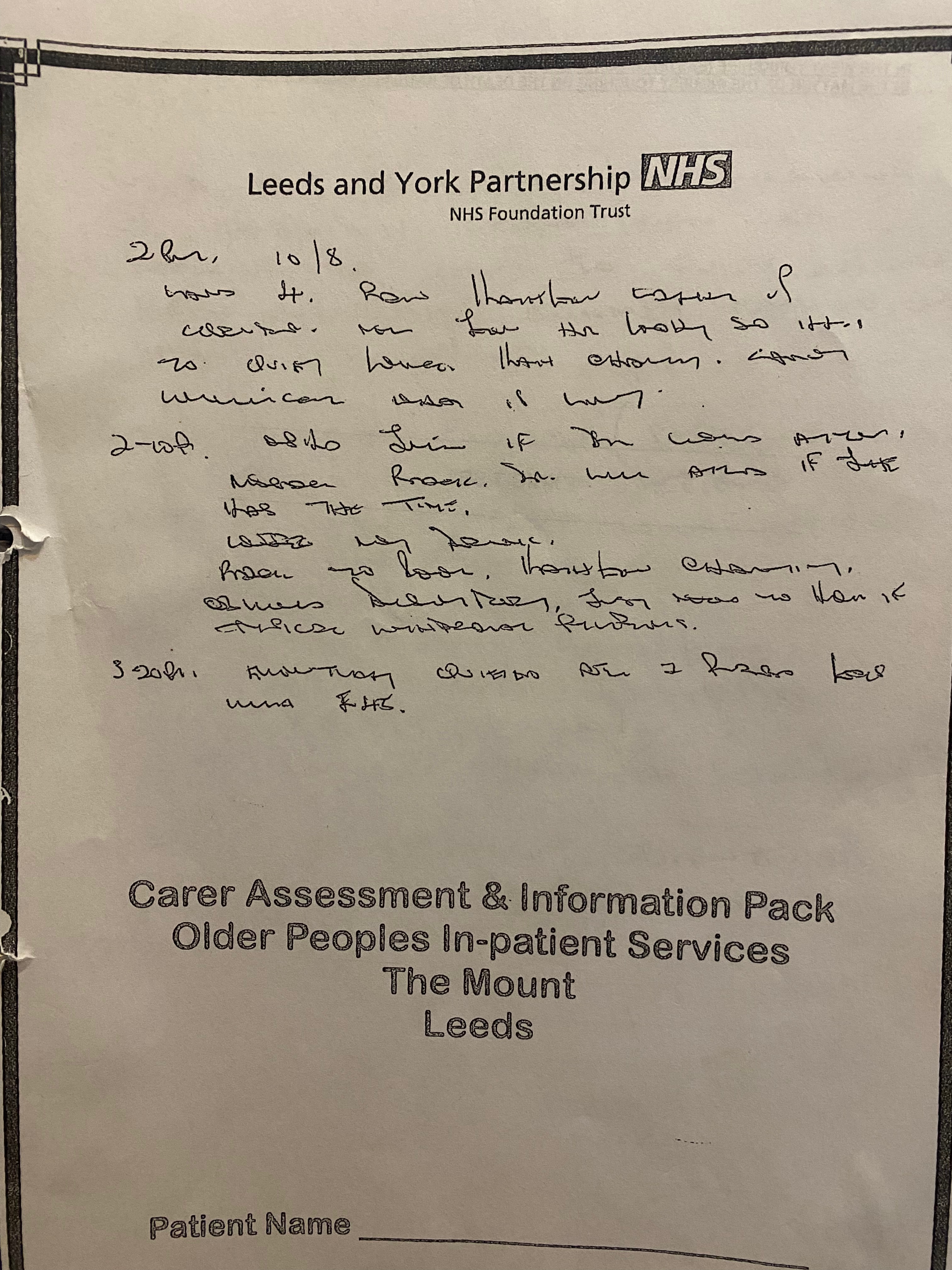
She returned 10 minutes later to tell me ‘ A doctor will attend if she had the time.’
I later discovered that the doctor on duty was a Dr Aneela Javed.
That was Emily Carson’s only contact with either me or Kathleen that day.
No-one came.
I intended to make a further complaint about that failure to attend and to use it in the application to have Kathlen’s section lifted.
I therefore made a note of events on a form, I found in Kathleen’s room, as some sort of corroboration. [3]
Kathleen eventually quietened and I thought the crisis was over.
I realise now that Kathleen was dying.
Paul Kiely was the charge nurse on duty.
I did not know, at that time, he was the male nurse who had been abusive towards Kathleen.
I told him Kathleen was poorly, Kathleen may be frightened on awakening and asked for permission to stay, with Kathleen, following visiting hours.
He refused to allow me to do so.
I saw Paul Kiely on my return for the evening visit.
I again told him how poorly Kathleen I believed Kathlen had become.
Kathleen appeared to be asleep for almost all visiting time
Kathleen never spoke at all that day.
On leaving I told the night charge nurse, Joyce Chubururu, how poorly Kathleen was and asked her to keep a close watch.
Kathleen died in the early hours of the morning.
I was in the process of writing out the application to have the section lifted when the police arrived to tell me Kathleen had died.
The letter
Shortly after Kathleen’s death, I was visited by a Coroner’s officer.
He did not ask me about Kathleen’s stay at the Mount.
He merely took a statement regarding Kathleen’s family and medical background.
I thought it was important that the coroner should be aware of Kathleen’s treatment at the Mount and, particularly, the doctor’s failure to attend.
I believed Kathleen may have survived if treatment had commenced at 2pm on 10 August.
On the 14 August 2017, three days after Kathleen’s death, I sent a letter, via e-mail, addressed to Mr Firth, the Coroner’s officer, with details of my concerns, particularly, the doctor’s failure to attend upon Kathleen.[4]
I ended the letter by requesting Mr Firth to bring the contents to the attention of the coroner
I cannot overemphasise the significance of that letter.
It was sent within 3 days of Kathleen’s death and before I could know anything of the Mount case.
The letter pointed out that it was only 10 minutes before my request to Emily Carson and her return.
I did not see Emily Carson again that day.
Any medical tests, following my arrival at the hospital, would have had to have been carried out, by Emily Carson, in my presence and within that10 minutes.
They were not.
The letter also referred to the note I had made in Kathleen’s room.
Therefore, it cannot be said the note was written, later, in response to the Trust version of events.
All material in the inquest process is served on the coroner.
My letter was sent to the coroner three days after Kathleen’s death.
Therefore, the coroner would be aware of my concerns, regarding Kathleen’s care, the failure of a doctor to attend upon Kathleen, and my note, at that time.
What happened to that letter, in view of the way the inquest was later conducted, assumes even greater significance, when considering the fairness of the inquest proceedings.
The coroner instructed a Dr da Costa, from the Sheffield NHS Trust to report upon the standard of care received by Kathleen at the Mount.
The coroner did not forward my letter to Dr da Costa.
Dr da Costa was only given my statement, taken by the coroner’s office, which merely dealt with Kathleen’s family and medical history.
Therefore, the doctor was only in possession of the Trust version of events of 10 August 2017.
However, a copy of my letter was sent to the Mount, alerting management of my concerns, before any statements were taken from the hospital staff.
It enabled the Trust to manufacture a defence to possible criminal charges.
Apart from the copy sent, by the coroner, to the Trust, the letter never saw the light of day.
I retrieved a copy, from the coroner’s office, many months after Kathleen’s inquest had been held.
The cover up
Following the death of a person detained under the Mental Health Act the National Patient Safety Agency sets out the guidance for Trusts.
An initial internal investigation should be held within 72 hours.
I believed that investigation might reveal whether Dr Javed had been requested to attend upon Kathleen or not on the afternoon of 10 August 2017.
Many months after Kathleen’s inquest had taken place I requested details of the review.
I was informed that no such review had taken place.
On 25 October 2017 I received a telephone call from Gina Wills, a psychologist at the Mount.
She told me she had been tasked, by the coroner, to report upon Kathleen’s treatment at the Mount.
I agreed to see her.
On the 8 November 2017 I was visited by Gina Wills at my home.
My major concern was the failure of a doctor to attend upon Kathleen.
I left Gina Wills in no doubt about that.
After some 2 hours I said something to the effect that I expected such an investigation would have been carried out by the coroner’s officer.
She then told me that there must have been some understanding and that the report was not for the coroner but simply for the Mount hospital.
Gina Wills was in possession of a copy of the letter I had sent to the coroner’s office on 14 August 2017. [ 4].
The letter set out all the allegations the Trust had to counter if it was to avoid serious charges against the Trust and its staff.
It referred to the doctor’s failure to attend.
I was angry at being misled by Gina Wills.
On 10 November 2017, 2 days after her visit, I sent a further e mail to the coroner, questioning Gina Wills’ motives in approaching me. [5]
Months later I was served with the statement of Paul Kiely [6] and a report by Gina Wills.[7]
Paul Kiely’s set out the Trust defence to a possible charge of manslaughter against Dr Javed or at least a charge of a serious breach of a duty of care.
Paul Kiely stated that on 10 August 2017, on becoming aware of my concerns, he directed various medical tests to be carried out upon Kathleen.
Those medical tests are referred to as MEWS tests.
MEWS stands for modified early warning system and monitors, amongst other things, heart rate, blood pressure and respiratory measurements.
Paul Kiely stated the results of those tests gave no cause for concern.
He discussed the findings with Dr Javed.
Together, they decided Dr Javed need not attend.
He went further.
Far from refusing me permission to stay with Kathleen he stated I had stayed and helped him to feed Kathleen.
He stated that I had expressed no further concerns regarding Kathleen’s condition.
As we shall see, there was not one word of truth in that statement.
Gina Wills produced a report without even mentioning Dr Javed’s name.
At page 10, she stated that staff did not inform a doctor because observations were within normal limits.
At page 12 she stated that the student nurse approached the doctor to report concerns but had no information whether this was followed up.
Either Gina Wills did not interview Dr Javed or, she did, Dr Javed refused to lie.
At Kathleen’s inquest Dr Javed had no recollection of being approached by either Paul Kiely or Emily Carson
I requested a copy of Kathleen’s medical records regarding her stay at the Mount.
The medical records are referred to, by staff, as the Paris notes.
The entry in Kathleen’s Paris notes, for the afternoon of 10 August 2017, was entered at 7.26pm that day and was exactly 5 lines in length.[8]
The entry was signed by Emily Carson
It stated quite clearly that only one Mews test had been carried out upon Kathleen that day, and that was before my arrival at the Mount.
‘Mews done prior’.
There was no mention of a doctor being consulted or any discussion between Paul Kiely, Emily Carson or Dr Javed.
I was later served with the statement of Dr Javed.[9]
She was assisted in the making of that part of her statement which referred to 10 August 2017, by Peter Merchant, solicitor for the Mount.
Dr Javed made no mention of being approached by either Paul Kiely or Emily Carson on 10 August 2017, although she did remember seeing Kathleen, in the hospital corridor, at 12.30pm that day which suggests Dr Javed had some recollection of the day.
I requested a statement from Emily Carson.
It was many months before her statement was served on me.
There was a preliminary hearing at the coroner’s Court.
The coroner appointed Dr da Costa, of the Sheffield NHS Trust, to report upon Kathleen’s treatment at the Mount.
Dr da Costa was given the statement of Paul Kiely and the report of Gina Wills.
He was not given the letter I had sent to the coroner.
Therefore, Dr da Costa was only in possession of the Trust version of events for the 10 August 2017.
In view of the way Kathleen’s inquest was later conducted, I do not believe that the failure to send the letter to Dr da Costa was an oversight.
Whilst Dr da Costa, in his first report [10], stated that the level of care, afforded Kathleen, was below that to be expected, he did not consider it to be causative in Kathleen’s death.
He noted that the MEWS test was carried out before my arrival, at the Mount, and criticised the student nurse for not alerting more senior colleagues.
He stated that even if treatment had been commenced in the late evening of10 August 2017 then Kathleen would still have died when she did.
If he had been given my letter, by the coroner, he would have known that the opportunity for treatment was much earlier.
I was eventually served with the statement of Emily Carson.[11]
Her statement was dated 13 December 2018, some 16 months after Kathleen’s death.
Emily Carson’s statement could not have been more ambiguous.
However, it was not the statement of a young student nurse writing out her own account.
It was a statement made with the assistance of Peter Merchant, solicitor for the Trust.
In para 5 of her statement, Emily Carson appeared to say that the MEWS test had been undertaken before my arrival at the Mount on 10 August 2017
In para 6 she stated the test had been carried out after my arrival, and in answer to my concerns.
Para 6 not only contradicted para 5 it contradicted her own entry in Kathleen’s medical notes.[8]
In Para7 of her statement Emily Carson appeared to contradict the statement of Paul Kiely.
In that Para 7 she stated that having spoken to me and carried out the MEWS test she relayed the results to Paul Kiely.
No mention that the MEWS test was carried out on the directions of Paul Kiely.[6]
In my letter to the coroner, [4] I had described my contact with Emily Carson on 10 August 2017.
A matter of a few seconds, 10 minutes apart.
Although Emily Carson’s statement is ambiguous it still leaves only three possible scenarios.
Firstly, the MEWS test carried out before my arrival at the Mount.
That is corroborated by the entry in the Paris notes.
There is also my evidence which seems to have been completely ignored by everyone.
Secondly, Emily Carson spoke to Paul Kiely and was directed to carry out the MEWS test.
Thirdly, Emily Carson carried out the MEWS tests on her own initiative.
At the time of Kathleen’s death Emily Carson was in the first year of her training and on her first placement.
Whether she would have acted on her own initiative, in those circumstances and at that time in her career is open to question.
If MEWS tests were carried out after my arrival at the Mount they had to have been carried out in my presence.
They were not.
The Mews tests include the taking of blood pressure.
Blood pressure machines are kept on trolleys at the Mount.
If Emily Carson carried out the tests on her own initiative, she would have to locate a trolley and bring it to the room where me and Kathleen were.
She would have to carry out the various tests including taking Kathleen’s blood pressure.
In her statement she said that she had relayed the results to Paul Kiely, who she described in her statement as her mentor.
She stated that she discussed the results with Dr Javed.
She stated that she then returned to me to tell me she had passed on my message to Dr Javed.
All that in that in the space of10 minutes.
Had Emily Carson taken my concerns to Paul Kiely and been directed to carry out a MEWS test then even more time would have elapsed.
Emily Carson did not state whether she informed me of the results of the MEWS test.
Had MEWS tests been carried out in my presence, I would have wanted to know the results.
I am not sure that I would have accepted that there was no reason for a doctor to attend with Kathleen struggling to breathe at my side.
On the second to last page of the report by Gina Wills there is the following entry for 10.8.17
Page 29.[12].
‘Kath’s husband expressed concern about Kath’s physical health as she wasn’t responding, looked poorly and was sweating. A MEWS TEST HAD BEEN CARRIED OUT EARLIER @ was normal. Kath had been observed to be more anxious earlier in the day.’
I knew, of course, that Paul Kiely had lied about allowing me to stay with Kathleen.
To prove the lie, I requested the visitor records from Kathleen’s hospital ward.
Visitors are required to sign in and out following visits.
Ward copies were served on me and the signing out column was blank.[13]
The record appeared to corroborate Paul Kiely’s statement.
I do not believe I ever failed to sign in or out.
Any secretary knows that, with correction fluid and a copying machine, entries on copies can easily be erased without trace.
I then requested the visitor records from The Mount’s main reception where, again, visitors are required to sign in and out.
Those records were requested, by my solicitor, on 3 April 2019.[14]
The records were served on me a few days before the inquest, in November 2019.[15]
A delay of 7 months.
Those records showed that I had signed out and proved that Paul Kiely had lied in his statement.
Had those records been served in a reasonable time I would have brought that evidence to the attention the coroner.
The late service prevented me from doing so.
I have no doubt that the late service was deliberate.
As previously explained all evidence is served on the coroner.
The coroner would know, on receiving the visitor records, that Paul Kiely had made a false statement for the inquest.
The coroner could not know what evidence Paul Kiely would give unless Peter Merchant told him.
Amongst other material, served upon me for Kathleen’s inquest, was the form used to show the results of the tests, ostensibly carried out upon Kathleen, by Emily Carson on 10 August 2017.
I have carried out many enquiries since the inquest.
I noticed that date recorded on that form used to record the results of those medical tests, said to have been completed by Emily Carson on 10 August 2017, and the actual results entered, had been made my different hands.[16]
Unlike an earlier entry, made by Emily Carson, it was not signed or initialled.[17]
I asked to see Kathleen’s original medical records, held at Seacroft hospital.
I examined the form in the file, in the presence of Eve Townsley, who was employed by the Trust.
The original form was missing.
There was a copy in its place.
The Inquest
People may think, and I was amongst them, that the purpose of an inquest is to investigate all the circumstances of a death and discover the truth.
It is not.
An inquest is simply held to determine the cause of death.
Once a cause of death is established the inquest, to all intents and purposes, is over.
A coroner may comment on the truthfulness, or otherwise, of a witness.
There is no duty on him to do so.
A successful cover up may be achieved, by an NHS Trust, if two of its witnesses maintain an untruthful version of events against that of a single witness on the opposing side.
A problem arises for the Trust, if documentary evidence is discovered which proves that those witnesses cannot be telling the truth.
The only possible way the Trust case could be salvaged under those circumstances, is if evidence of a death by natural causes is established before the witnesses give their evidence.
Some witnesses lie very well under oath, others may crack under the pressure.
It is usually the young, inexperienced, witness who crack.
On the day of the Inquest, I was served with the second report of Dr da Costa.
Dr da Costa had now seen the statement of Emily Carson.
Contrary to his earlier report, he now appeared to accept that she had carried out the MEWS tests upon Kathleen after my arrival at the Mount.
I had asked that Dr da Costa, specifically, to report upon two things.
Whether Lorazepam could have caused the pneumonia and whether Kathleen would have survived if a doctor had attended and treatment commenced at 2pm, not 8pm on 10 August 2017.
He discounted the first and failed to address the second.
My barrister requested an adjournment for us to instruct our own expert.
The coroner refused the application.
The late service of the report had made it an easy decision to justify.
The witness list order, for Kathleen’s inquest had been fixed, and served on me, some 6 months previously.[18]]
On the second day of the inquest, I was informed there would be a change to the witness order.
I was informed that Dr da Costa was due to give evidence in Edinburgh on 14 November 2019.
I was told that Dr da Costa would now be called, to give evidence, on 13 November and Emily Carson and Paul Kiely would give their evidence the following day, in that order.
Kathleen’s inquest had been fixed for at least 6 months.
I later retrieved an e-mail, dated 23 October 2019 between the coroner’s office and Peter Merchant, solicitor for the Trust. [19].
The email confirmed that Emily Carson, Paul Kiely and Dr da Costa would give their evidence in the order listed 6 months previously.
That means that any notification, from Edinburgh, must have arrived between 23 October and 11 November 2019.
Cases involving expert witnesses are always listed well in advance.
Dr da Costa and the coroner would know of any possible clash of venues months before the beginning of Kathleen’s inquest.
Certainly, by 23 October 2019, if there was to be a possibility that Dr da Costa may be needed to give evidence elsewhere during the week of the inquest, there should have some reference to it in the e-mail.
In view of the effect that change of witness order had on the inquest, I find the explanation I was given very difficult to believe.
I was called to the witness box.
Although my evidence contradicted that of at least three of the Trust witnesses, I was not asked a single question by either the coroner or Peter Merchant.
Peter Merchant would certainly have known that Paul Kiely was to change his story.
The coroner would not have known, unless Peter Merchant had informed him.
The only thing the coroner said to me was that this was my only chance to give evidence, I would not be recalled.
Dr da Costa gave his evidence.
He went further in his oral evidence than he had gone in his reports.
He stated that, in his opinion, Kathleen would still have died if treatment had been given 24 to 48 hours earlier.
I do not believe that to be true.
However, Dr da Costa’s evidence, without any form of medical challenge, meant that the coroner could accept that any failure to attend by Dr Javed did not contribute to Kathleen’s death.
The coroner could now bring in a verdict of death by natural causes.
There was still the question of the lies told by Paul Kiely and Emily Carson.
Emily Carson was due to give evidence next.
There was another change in the witness order, Paul Kiely was called to give evidence, not Emily Carson.
He stated that he had ‘Misspoke’.
He stated, on oath, he had mistakenly based his statement partly on what action he would usually take and partly on an entirely different day.
He could not say that any part of his statement was true.
The truth is he had been caught out in his lies by the visitor record, he could no longer maintain his original statement.
Paul Kiely’s original statement was made by an experienced charge nurse, for a coroner’s inquest.
He would know the importance of the accuracy of such a statement.
The statement was made within weeks of Kathleen’s death.
He had access to Kathleen’s medical notes of 10 August 2017.
I have no doubt that his original statement was designed to obscure the truth and provide the Trust, and its employees, a defence to serious charges.
The complete change in Paul Kiely’s version of events was accepted by the coroner without comment.
Emily Carson was crying when called to give evidence.
She was asked if her statement was true.
She said, on oath, that it was.
She was the weak link who, I have no doubt, would have cracked under cross- examination.
She had made a statement which contradicted her own entry in Kathleeen’s medical records.
She had made a statement which contradicted the statement made by Paul Kiely.
She had made a statement which contained different versions of when the Mews test was carried out.
The coroner was as aware of that as anybody in the Court.
The coroner prevented any cross-examination of Emily Carson.
He chose not to instigate any enquiry into the evidence he knew to be untrue.
Dr Javed gave her evidence.
She stated she had no recollection of being requested to attend upon Katheen.
No recollection of any discussions with either Paul Kiely or Emily Carson that day.
She said she should have attended if requested to do so.
In a bid to discover when Dr da Costa had been warned to give evidence in Edinburgh, I sent e- mails to The Coroner’s office, and the office of Dr da Costa and asked for that information.
I was informed that the coroner was not subject to the Freedom of Information Act.
Dr da Costa’s office refused to disclose that information, citing data protection.
The coroner failed to forward my letter of 14 August 2017 [4] to Dr da Costa, thereby ensuring that his first report was based entirely on the Trust version of events.
That failure, by the coroner, meant the Dr da Costa based his first report on the statement of Paul Kiely, a statement later proved to be untrue.
The change in the witness order prevented any real examination of the false statements of Paul Kiely and Emily Carson.
The coroner refused to allow any cross-examination of Emily Carson.
At the conclusion of the inquest, the coroner stated he was satisfied that the tests upon Kathleen had been carried out in the afternoon of 10 August 2017.
Paul Kiely had been completely discredited as a witness.
The statement of Emily Carson contained so many contradictions as to be unreliable.
Yet the coroner, apparently, preferred their evidence to mine.
All those matters convinced me that the whole inquest procedure had been biased in favour of the Trust, from beginning to end.
The Solicitor
When I had exhausted every other avenue, I made a complaint to the Leeds and York NHS trust regarding the lack of care afforded to Kathleen, the lies told to cover up that lack of care, the failure of Gina Wills to question Dr Javed and the failure of Dr Javed to attend upon Kathleen.
I expected a whitewash, and I was not disappointed.
I thought, at least, my complaint might dissuade staff at the Mount from taking part in another, similar, cover up.
My complaint was investigated by a Ms Haywood- Sampson, described as a senior investigator for the Trust.
In her report,[20] she stated that neither Dr Braxton, nor Dr Javed, was employed by the Trust.
She stated that no-one of the name of Emily Carson was employed by the Trust.
She stated that Gina Wills’ failure to address my complaint, of Dr Javed’s failure to attend upon Kathleen, was simply a gap in Gina Wills’ investigation.
Strikingly, Ms Haywood-Sampson’s report criticised the solicitor, who assisted Paul Kiely in the making of his statement, for a lack of rigour.
I asked the Trust to identity the solicitor involved.
I was then informed that senior investigator Ms Haywood- Sampson had made a mistake and that no solicitor was involved in the taking of Paul Kiely’s statement.
I do not believe Ms Haywood- Sampson would have made an error of that magnitude.
I was later informed that Peter Merchant, of Beachcroft solicitors, was the only solicitor involved in the case.
There was a marked similarity in the style of the statements of Paul Kiely, Emily Carson and Dr Javed.
I later made a complaint to the solicitor’s regulatory authority, based on the report of Ms Hayward-Sampson, that Peter Merchant had assisted in the making of the misleading statements of Paul Kiely and Emily Carson for Kathleen’s inquest.
I also complained about the late service of the visitor records which proved that Paul Kiely had lied.
The answers he gave to the authority are recorded here.[21]
Peter Merchant denied being involved in the taking of the statement of Paul Kiely.
He stated his firm did not become involved in the case until May 2018.
When Kathleen died, those at the Mount could not be sure that the failure of a doctor to attend had not contributed to Kathleen’s death.
The failure of a doctor to attend upon Kathleen may well have amounted to charge of manslaughter against Dr Javed.
I was asked to believe that the Trust did not seek legal advice until 9 months after Kathleen’s Death.
Peter Merchant admitted being involved in the taking of the statement of Emily Carson.
He stated that he had pointed out the contradiction between her statement and her own entry in Kathleen’s medical notes.
In accepting that there was a contradiction, he was also accepting that the Paris note recorded that the Mews test was carried out before my arrival at the Mount.
Otherwise, there was no contradiction.
He stated that Emily Carson, the young student nurse, insisted on the wording of her statement, despite the documentary evidence which proved the lie.
I would have expected a solicitor, of Peter Merchant’s experience, to advise Emily Carson to explain the obvious contradiction between her entry in the Paris note and the written statement she was now making.
It may be that there wasn’t one.
Peter Merchant admitted being involved in the making of the statement of Dr Javed.
Common sense dictates that there must have been some discussion of the statements of Paul Kiely and Emily Carson.
I can only conclude that Dr Javed refused to corroborate the versions of Paul Kiely’s and Emily Carson.
In relation to my complaint regarding the late service of the visitor records from the Mount main reception, I received the following response.
‘The firm advised it only became aware of the building sheets in November 2019 ‘.
‘The firm explained that they were disclosed as part of the client’s ongoing obligation of disclosure not in response to a request from you or any third party’.
Those were the records which proved Paul Kiely’s statement was false.
I recovered e-mails between the coroner’s office, my solicitor and Peter Merchant.
The e-mails showed that the request was made, for the records from main reception, on 5th April 2019 [22] and that Peter Merchant was certainly aware of the request as early 17 April 2019.
In his final speech at Kathleen’s inquest, Peter Merchant stated that the Mews test could have been carried out at any time in the afternoon of 10 August 2017 even after my departure.
West Yorkshire Police
The day after the inquest, on 16 November 2019, I made a complaint to West Yorkshire Police that, by lying in their statements, Paul Kiely and Emily Carson had attempted to pervert the course of justice.
I was later visited by a PC Rodgers who informed he had been designated to investigate my complaint.
Although in plain clothes the fact that he addressed himself as PC, suggested that he was an inexperienced aide to CID rather than a seasoned detective.
This was not a case for an inexperienced officer.
He took my papers.
I heard nothing for 5 months.
I expected that interviews had been carried out and a file submitted to the CPS.
I contacted the CID and spoke to a Detective Sergeant Liz Smith.
She told me that PC Rodgers had been involved in a road accident and had been off work for over 4 months but would be back in in the next fortnight.
The case had not been re-allocated.
That delay caused a problem for West Yorkshire Police.
Should the case proceed to Court then West Yorkshire Police would be criticised by Defence Counsel and the presiding Judge for the delay and the fact that the case had not been re-allocated.
I was eventually told that West Yorkshire Police were not going to proceed as there was some doubt as to when the MEWS test was carried out upon Kathleen.
Even Peter Merchant accepted that the Paris note showed that the Mews test was carried out before my arrival at the Mount.
There was my evidence that no Mews test took place after my arrival.
Evidence which has never been challenged.
Against that there was the statement of Paul Kiely who, confronted by the visitor records, had to change the version of events he had maintained for over 2 years.
A statement he said he had based on an entirely different day.
There was the statement of Emily Carson which contradicted her own entry in the Paris notes.
West Yorkshire Police decided that there was insufficient evidence even to proceed to interview.
I did some research and discovered that Dr Javed’s failure to attend was a specific, serious, offence of a failure of a duty of care under the Mental Health Act
I made a further complaint, to West Yorkshire Police, of that failure of a duty of care.
Initially, I was informed that DS Smith did not think there was such an offence.
I was then told my complaint would not be pursued.
I was later informed, by a Detective Inspector Entwistle, that he proposed to take no further action because any failure of care did not lead directly to Kathleen’s death
Conclusions
I don’t know whether Kathleen would have survived if a doctor had attended at 2pm Thursday 10 August 2017.
I know that any chance of survival Kathleen had was lost by that failure.
I do know that Paul Kiely maintained a totally untrue version of events for over 2 years, until confronted with the visitor records that proved the lie.
Emily Carson would have been under terrific pressure to lie and lie she did.
Her statement contradicted her own entry in Kathleen’s medical records.
Her statement contradicted that of Paul Kiely.
Dr Javed did not lie but neither did she tell the absolute truth.
The failure of the coroner to serve my letter on Dr da Costa prevented the preparation of a balanced report.
The service of the letter on the Trust enabled the Trust to manufacture a defence.
I do not believe the failure to serve the letter, upon Dr da Costa, was an oversight.
I do not believe the reason I was given for the change of witness order at the inquest.
I do not believe that Emily Carson would have stood up to cross-examination.
The coroner prevented that cross examination.
For those reasons, I believe that the whole inquest process was biased in favour of the Trust, from start to finish.
Peter Merchant admitted being involved in taking the statements of Emily Carson and Dr Javed.
I saw the similarities in style between those statements and the statement of Paul Kiely.
Ms Sampson- Hayward initially criticised the solicitor who had assisted Paul Kiely to make his statement.
Then, perhaps realising how damaging that information was to the Trust case, she stated she had made a mistake, and a solicitor was not involved.
Peter Merchant denied being involved in the making of the statement of Paul Kiely and stated he had not been involved in the case until May 2018.
I do not believe that the Trust waited 9 months before seeking legal advice.
Peter Merchant’s explanation for the late service of the visitor records was untrue.
The West Yorkshire Police officers failed in their duty.
Even Peter Merchant accepted that the entry in the Paris notes showed the Mews test was carried out before my arrival at the Mount.
A professional investigation would have sent out a powerful message to those involved in the care of the most vulnerable and who abuse that care.
As I have discovered, a coroner has absolute power in his own courtroom.
His decisions, under the guise of independence, are almost impossible to challenge.
A Coroner can determine the outcome of an inquest, from the outset, by suppressing, or ignoring, any evidence he wishes.
Such a system would not be allowed in any other area of law.
I was naive enough to believe that a Coroner would have a moral duty discover the truth and to protect the most vulnerable.
Mr Leach proved me wrong.
Shaun Beardsmore
 A Cover Up Uncovered